Buyer guideEgy Berries Team · 22 October 2026
Frozen Fruit for Freeze-Drying: What Chinese FD Plants Specify from Egypt
Why the frozen lot decides the freeze-dried result
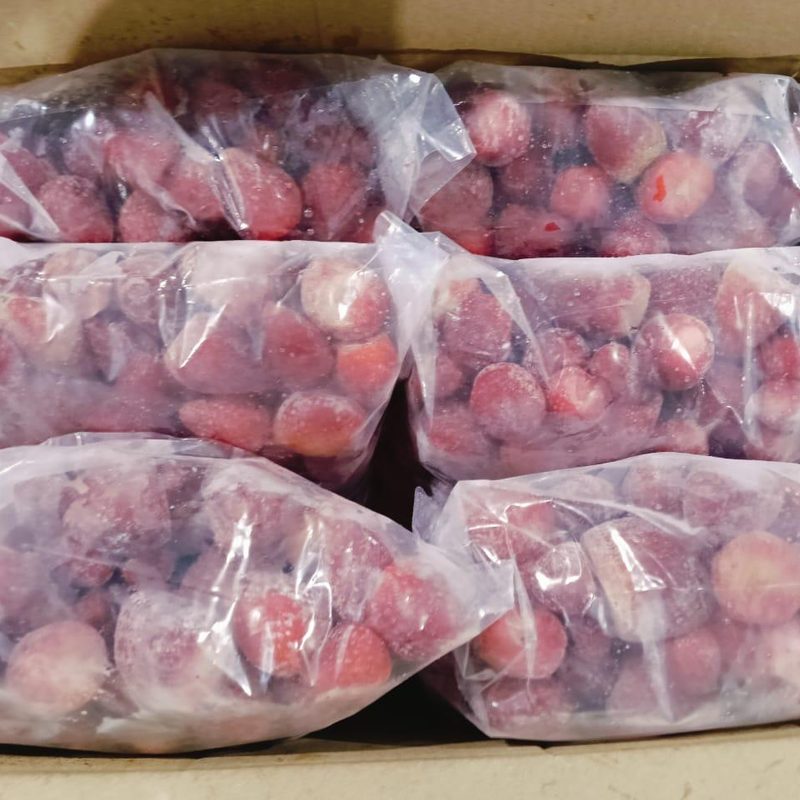
Freeze-drying removes roughly nine tenths of the weight of a strawberry and changes almost nothing else. Whatever is in the fruit at freezing is still there at the end, in a piece that now weighs a tenth as much. That single fact explains every specification a freeze-drying plant sends out.
It means a pale lot dries to a pale crisp, an uneven lot dries to an uneven bag, and a lot sitting just inside a residue limit can come out of the dryer above it. It also means the plant cannot fix anything after delivery. A retail importer can sell a slightly soft strawberry; an FD plant cannot sell a slightly grey crisp. The quality decision was made in the field and on the freezing line, months before the pallet arrived.
1. Residues: EU and FDA limits, with headroom
Chinese freeze-drying plants almost never sell only into China. Their crisps, powders and snack inclusions go on to the EU, the United States, Japan and Korea, so they buy raw material that already satisfies the strictest standard in their customer list — in practice EU maximum residue levels under Regulation (EC) No 396/2005 and the tolerances enforced by the US FDA.
The concentration effect is why they ask for more than bare compliance. Residue limits are set on the product as it is marketed, and a dried product is a different, much more concentrated product than the frozen fruit it came from. A lot that tests at, say, 80 % of an EU limit while frozen is not a comfortable lot once the water is gone. Serious FD buyers therefore specify a margin — a percentage of the limit rather than the limit itself — and they want the residue report on the actual lot, not a generic annual certificate.
What that asks of the grower is control over the spray programme, not better testing at the end. Testing finds a problem; the treatment plan prevents it. This is also the reason the next point matters so much.
2. Single-farm lots under one treatment programme
A lot blended from six farms carries six spray programmes, six harvest dates and six maturity profiles. Even when every farm is compliant, the blend is unpredictable: residues vary across the pallet, sugar varies, and drying behaviour varies with it. An FD plant running a fixed cycle on a fixed tray loading cannot absorb that variation, so it shows up as uneven crisps and rejected bags.
A single-farm, single-treatment lot removes the variable. One field, one agronomy plan, one harvest window: the residue profile is consistent, maturity is consistent, and the dryer behaves the same way from the first tray to the last. Chinese buyers who run tight processes increasingly ask for this by name, and they are right to.
It has to be contracted early. Dedicating a field and fixing its treatment programme is an agronomy decision taken before the season, not a sorting decision taken at loading. If single-farm traceability matters to your process, raise it when you agree volumes for the coming season and we will plan the supply around it.
3. Brix: the number that sets your yield
Brix measures soluble solids. In a freeze-drying plant it is close to a yield calculation: the dry matter is what remains after the water sublimates, so a higher-Brix strawberry gives more finished product per tonne of raw material, a firmer structure that survives handling, and a sweeter crisp that needs no added sugar. A low-Brix lot gives fragile pieces, more fines at the bottom of the bag, and a flat taste.
Egy Berries strawberries are supplied at a minimum of 7° Brix, from the Festival and Fortuna varieties. Brix moves with variety, weather and picking date, so the sensible contract fixes a minimum and states how it is measured and on which sample, rather than quoting one number from one pallet.
Buyers who want to work at a higher minimum should say so before the season. Brix is driven by how long the fruit is allowed to ripen on the plant, which again is a field decision, not a sorting decision.
4. Colour
Freeze-drying does not hide colour, it reveals it. The porous structure of a dried piece scatters light, so a frozen strawberry that looked acceptably red becomes visibly dull once dried, and any browning at the calyx end becomes the first thing a consumer sees through the bag.
Good colour in the dried piece comes from fruit that was picked ripe but not over-ripe, chilled quickly, blanched or frozen without delay, and held without temperature fluctuation. Our fruit is frozen within hours of harvest and stored at −18 °C or colder throughout. For FD programmes we recommend agreeing a colour reference — a photograph or a physical sample retained by both sides — rather than words like "bright red", which mean different things in Cairo and in Qingdao.
What we supply to freeze-drying plants
Egy Berries is an Egyptian manufacturer and exporter of IQF frozen fruits and vegetables. For FD processors the relevant lines are frozen strawberries (whole 15–25 mm and 25–35 mm, diced 10×10 mm and 15×15 mm), frozen mango (whole, slices, dices) and frozen pomegranate arils. Bulk packing is 1 × 10 kg cartons with a food-grade liner; other formats on request.
Production runs under FSSC 22000 and GLOBALG.A.P., with ISO 22000, ISO 9001 and HACCP systems in place and BRCGS practices followed on the line. We are registered with the US FDA and with China's GACC, which is a precondition for shipping food into China under GACC Decrees 248 and 249.
Getting it into China
Three things decide whether a shipment of frozen fruit clears smoothly into China. The exporter and the production facility must hold a valid GACC registration (Decrees 248 and 249, in force since 1 January 2022) and the registration number must appear on the labelling. The consignment needs the standard export set — commercial invoice, packing list, bill of lading, certificate of origin and a phytosanitary or health certificate as required for the commodity. And the tariff classification must be right: frozen strawberries are HS 0811 10, frozen mango and pomegranate arils HS 0811 90.
On duty, goods originating in Egypt currently benefit from China's zero-tariff treatment for products from 20 African countries, announced by the State Council Tariff Commission (Announcement No. 5 of 2026) and GACC (Announcement No. 54 of 2026) and running from 1 May 2026 to 30 April 2028, subject to the origin rules and customs procedures set out in those announcements. Chapter 08 is not in the excluded lists. Confirm the position for your own HS line and your own certificate of origin with your broker before you contract.
The terms, in Chinese and English
Specifications travel between a purchasing office in China and a factory in Egypt, and words get lost. These are the terms we see most often on Chinese enquiries for freeze-drying raw material.
| 中文 | English | What it means on a contract |
|---|---|---|
| 速冻草莓 / 冷冻草莓 | IQF / frozen strawberry | Individually quick frozen, free-flowing, not block |
| 冻干原料 | Freeze-drying raw material | Frozen fruit bought to be dried, not to be resold frozen |
| 冻干草莓 / 冻干水果 | Freeze-dried strawberry / fruit | The finished product our customers make |
| 糖度 / 白利糖度 | Brix | Soluble solids; fix a minimum, state the method |
| 农残 / 农药残留 | Pesticide residues | Specify EU MRL or FDA, and the margin required |
| 单一农场 / 统一用药 | Single farm / one treatment programme | Contract before the season, not at loading |
| 整果 / 切片 / 丁 | Whole / slices / dices | State the size range in millimetres |
| 海关总署注册 | GACC registration | Required for the overseas facility; number on the label |
| 目的港 / 40尺冷柜 | Destination port / 40 ft reefer | About 24–26 t of strawberries in 10 kg cartons |
Frequently asked questions
Does Egy Berries supply freeze-dried fruit?
No. We are a frozen manufacturer and exporter. We supply IQF frozen strawberries, mango and pomegranate arils as raw material to freeze-drying plants, including plants in China, and we build the specification around what the dryer needs.
What Brix can you supply for freeze-drying?
Our strawberries are supplied at a minimum of 7° Brix, from the Festival and Fortuna varieties. Brix varies with variety, weather and picking date, so if your process needs a higher minimum, agree it before the season starts — it is decided by how long the fruit ripens in the field.
Can you supply a lot from a single farm with the same treatment programme?
Yes, on contract. Dedicating a field and fixing its agricultural treatment programme has to be planned before the season rather than selected at loading, so raise it when volumes are agreed. It is the most effective way to keep residues, Brix and colour consistent across a whole lot.
Do your residue levels meet EU and FDA requirements?
Our programme is managed against EU maximum residue levels under Regulation (EC) No 396/2005 and US requirements, and we agree residue testing on the lot before shipment. For freeze-drying we recommend specifying a margin below the limit rather than the limit itself, because drying concentrates whatever remains in the fruit.
Buying raw material for a freeze-drying line? 冻干原料采购
Send us the fruit, the cut, the Brix and residue margin you need and the annual volume, and we will come back with a specification and an offer. 欢迎微信联系。
WeChat 微信WhatsApp联系我们 ContactInformation as of October 2026. Sources: Regulation (EC) No 396/2005 on pesticide maximum residue levels; GACC Decrees 248 and 249 on registration of overseas food producers; State Council Tariff Commission Announcement No. 5 of 2026 and GACC Announcement No. 54 of 2026 on zero-tariff treatment for goods originating in 20 African countries, 1 May 2026 to 30 April 2028. Tariff and registration rules change — confirm with your customs broker before contracting.