Buyer guideEgy Berries Team · 22 October 2026
Frozen Molokhia from Egypt: Chopped or Whole Leaves, and What to Put in Your Spec
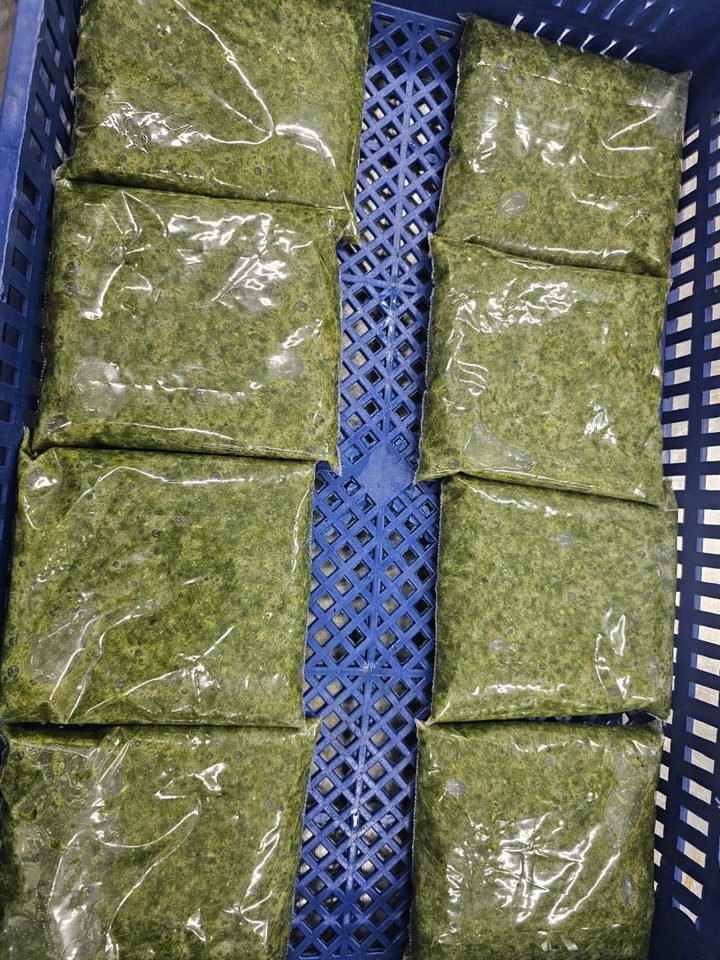
What molokhia actually is
Molokhia is the leaf of Corchorus olitorius, the jute mallow plant. It is known in English as jute mallow or Jew's mallow, and buyers will see it spelled molokhia, mulukhiyah, melokhia, mloukhiya or molokheya depending on the market. In West Africa the same leaf is sold as ewedu, in the Philippines as saluyot. In Egypt it is simply the national dish: a green soup thickened by the leaf's own mucilage, cooked with garlic and coriander and eaten with rabbit, chicken or rice.
That culinary history is why the product exists in the frozen trade at all. Molokhia wilts within hours of cutting, so the only way to move it to a shop in Hamburg, Dubai or Toronto in the condition a cook wants is to wash it, blanch it and freeze it within hours of harvest. Egypt grows it at field scale and has the freezing capacity next to the fields, which is why most of the frozen molokhia on the world market is Egyptian.
Chopped or whole leaves: the one decision that matters
Almost every question a first-time molokhia buyer asks comes back to this choice. Both products start from the same field and the same blanching line; the difference is what happens at the cutter.
| Chopped (minced) molokhia | Whole leaves | |
|---|---|---|
| Cut | Leaves finely cut after blanching, stalks removed | Leaf kept whole, destalked by hand or by machine |
| Texture when cooked | Thick and velvety — cutting the leaf releases far more mucilage | Lighter broth, leaves stay visible and separate |
| Cuisine | Egyptian and Gulf style soup, served with bread or rice | Lebanese, Syrian, Palestinian and Jordanian style, simmered with chicken |
| Typical buyer | Ethnic retail chains, cash and carry, food service | Ethnic retail in Levantine communities, restaurants |
| Usual packs | 400 g and 1 kg consumer bags; 10 kg bulk cartons | 400 g and 1 kg bags; 10 kg bulk cartons |
A practical rule: if your customer's recipe calls for molokhia to be blended or beaten before serving, they want chopped. If the recipe keeps whole leaves floating in broth, whole leaf is the only acceptable product — chopped molokhia cannot be turned back into leaves, and a container of the wrong cut will not sell.
Egy Berries supplies both: see frozen chopped molokhia and frozen molokhia leaves.
Season and when to contract
Molokhia is a hot-weather crop. In Egypt the harvest runs from May to September, with several cuttings taken from the same field as the plant regrows. Freezing happens in season; shipping happens all year from cold store.
What this means for a buyer is simple. Prices and availability for the coming twelve months are effectively set during those five months. Importers who only start asking in January are buying from whatever is left in store, usually at the worst price of the year. If molokhia is a line you repeat, agree volumes and cut before the season closes in September.
What to put in your specification
Molokhia is a leaf, so the quality problems are leaf problems: stalk, sand and colour. A specification that covers the points below removes almost every argument that happens later at the port.
- Cut: chopped (state the fineness you expect) or whole leaf. Never leave this to the packer.
- Stalk and stem content: the single most common complaint. Agree a maximum percentage of stalk by weight and how it will be checked.
- Colour: a bright, even green. Dull or olive leaves usually mean a blanching or freezing delay.
- Foreign matter and sand: molokhia grows close to the ground, so washing matters. Ask how many wash stages the line runs.
- Freezing method: IQF free-flowing, or block. Retail bags need IQF; some food-service buyers still take block.
- Temperature: −18 °C or colder through storage, loading and transit; ask for the loading temperature record.
- Microbiology and residues: state the limits of your destination market and who pays for the pre-shipment test.
- Metal detection and packaging: food-grade liner, carton specification, labelling language, barcode.
Egy Berries produces under FSSC 22000 and GLOBALG.A.P., with ISO 22000, ISO 9001 and HACCP systems in place, and is registered with the US FDA and China's GACC.
HS codes, and why molokhia trade data is misleading
Molokhia has no customs code of its own. Frozen molokhia — chopped or leaf — is classified under HS 0710 80, "other vegetables, frozen", the same heading that carries okra, artichoke, carrots and peppers. Dried molokhia falls under 0712 90, another catch-all.
Two consequences follow. First, any published figure you see for "molokhia exports" is really the total for a basket of unrelated vegetables, so treat it as background, not as market data. Second, because the code says nothing about the product, your commercial invoice and packing list must describe it precisely — "frozen chopped molokhia (jute mallow leaves, Corchorus olitorius), IQF" — or you invite questions at clearance. The eight- or ten-digit extension of the code is set by the destination, so confirm it with your own customs broker. Our HS code guide for frozen fruit and vegetables from Egypt works through how the code is built.
Importing into the EU and the UK
Frozen molokhia from Egypt is not on the EU's list of goods subject to temporary increased official controls. Commission Implementing Regulation (EU) 2026/194, which applies from 18 February 2026 and amends Regulation (EU) 2019/1793, lists Egyptian sweet and chili peppers at 30 %, vine leaves at 50 %, mango, sugar apple and strawberries at 20 % and oranges at 10 % — jute mallow appears nowhere in the annexes, for Egypt or for any other origin.
In practice that means no increased-frequency identity and physical checks and no CHED-D pre-notification purely on the grounds of the increased-controls list. The ordinary rules still apply in full: pesticide maximum residue levels under Regulation (EC) No 396/2005, general food law traceability, and correct labelling in the language of the member state. Because the list is reviewed roughly every six months, check the current version before each season rather than relying on last year's position. The same logic applies in the UK, which runs its own retained version of the list.
Packing options
| Pack | Format | Who takes it |
|---|---|---|
| Bulk | 1 × 10 kg carton with food-grade liner | Repackers, industry, food service |
| Food service | 10 × 1 kg or 4 × 2.5 kg | Restaurants, caterers, cash and carry |
| Retail | 20 × 400 g Egy Berries bags | Ethnic retail chains, supermarkets |
| Private label | On request, your artwork | Importers with their own brand |
Where frozen molokhia sells
Demand follows the kitchens that cook it. The core markets are the Gulf and the wider MENA region; Levantine, Egyptian and North African communities across Europe — Germany, Belgium, the Netherlands, France, Sweden and the UK are the usual entry points; and North America, where ethnic retail in the United States and Canada carries it year-round. EastFruit reported in January 2025 that Egyptian molokhia processors already ship to Belgium, England, Germany and a number of Arab countries.
It is a loyal, repeating line rather than a volume commodity. A shop that lists the right cut sells the same pack every week, which is exactly why getting chopped versus leaf right at the first order matters more than shaving a few cents off the price.
Frequently asked questions
Should I buy chopped molokhia or whole leaves?
It depends entirely on the cuisine of your end customer. Egyptian and Gulf cooking uses finely chopped molokhia to make a thick soup; Lebanese, Syrian, Palestinian and Jordanian cooking uses whole leaves simmered with chicken. The two are not substitutes, and chopped product cannot be converted back to leaves.
What is the HS code for frozen molokhia?
Frozen molokhia is classified under HS 0710 80, "other vegetables, frozen". There is no dedicated heading for molokhia, so the description on your documents has to do the work the code does not. The eight- to ten-digit national extension depends on the destination country.
Does frozen molokhia from Egypt face increased EU border checks?
No. Jute mallow is not listed in the annexes to Regulation (EU) 2019/1793 as amended by Regulation (EU) 2026/194, for Egypt or any other origin, so no increased-frequency checks apply on that basis. Normal EU import rules, including pesticide MRLs, still apply, and the list is revised about every six months.
Why is molokhia slimy, and is that a fault?
It is not a fault — it is the point. Jute mallow leaves contain natural mucilage, and cooking releases it to give the dish its body. Chopping the leaf breaks more cell walls and releases more of it, which is why chopped molokhia thickens a soup and whole leaves do not. A buyer who wants a lighter broth should order leaves.
Need molokhia in the right cut?
Tell us chopped or whole leaf, the pack format and the destination market, and we will come back with a specification and an offer.
Message us on WhatsAppRequest a quoteInformation as of October 2026. Sources: Regulation (EU) 2019/1793 as amended by Commission Implementing Regulation (EU) 2026/194 (applicable 18 February 2026); Regulation (EC) No 396/2005 on pesticide maximum residue levels; EastFruit, 23 January 2025. Import rules change — confirm the current position with your customs broker before shipping.