
Buyer guide Egy Berries Team · 7 October 2026
How to Write a Frozen Strawberry Specification: A Checklist for Importers
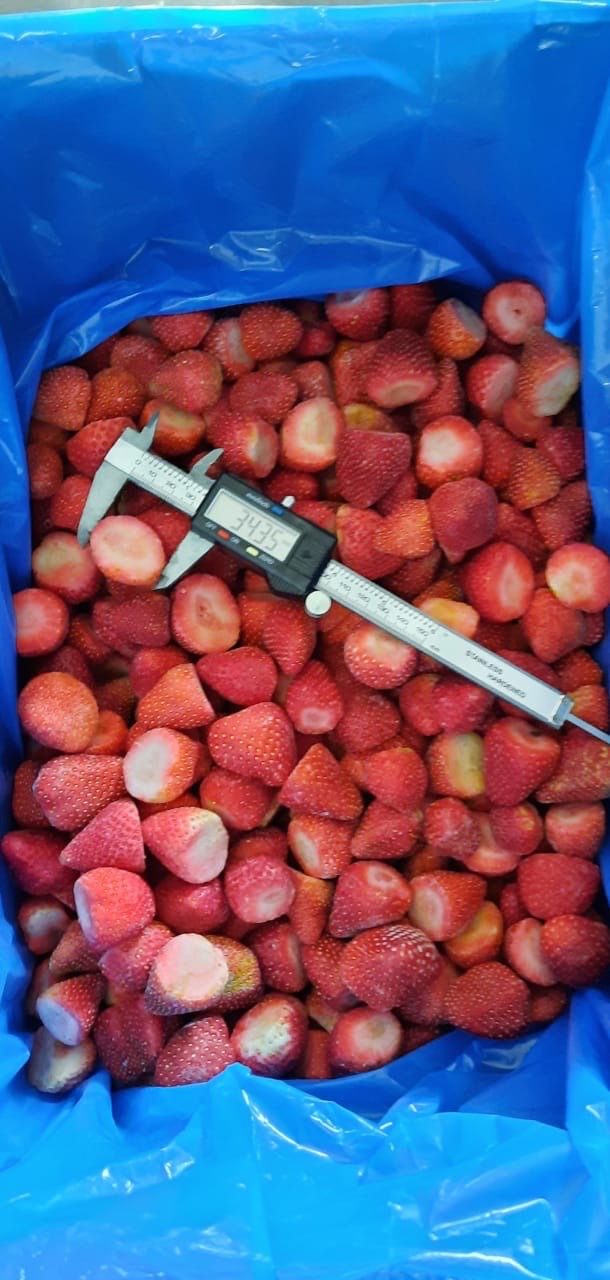
Whether you buy for a retail chain, a dairy or a bakery, a clear specification is the best tool you have to get what you pay for. Use this checklist with any frozen strawberry supplier, then attach the agreed version to your purchase contract.
1. Product identity
- Product name and format: IQF whole, diced or sliced (not sure which? read IQF frozen strawberries: what buyers should know).
- Variety, or "variety mix allowed". Egyptian processors freeze varieties such as Fortuna, Festival and Sensation.
- Country of origin and crop year or production date.
- Ingredients: "100% strawberries, no added sugar", or the exact sugar ratio.
2. Cut size and calibre
- Whole: a size range in millimetres and the tolerance outside it (for example "max. 10% outside range").
- Diced: cube size, such as 10×10 mm or 15×15 mm, and the allowed share of small pieces and fines.
- Sliced: slice thickness and tolerance.
3. Quality grade and defect tolerances
State the grade (for example Grade A for retail, or industrial grade for processing), then set a limit for each defect, as a percentage by weight or a count per kilogram:
- Calyx or stems remaining
- Clusters and clumps (for IQF)
- Crushed or mechanically damaged fruit
- Unripe fruit or white shoulders
- Overripe or soft fruit
- Mould or rot: zero tolerance
- Extraneous vegetable matter (leaves, stalks)
- Foreign matter (stones, glass, metal, plastic): zero tolerance
Add the sensory points: typical red colour, typical strawberry taste and smell, and no off-flavours.
4. Chemical requirements
- Pesticide residues: compliant with the maximum residue levels of the destination country, in the EU Regulation (EC) No 396/2005. For Egyptian strawberries entering the EU, also see EU border checks in 2026.
- Contaminants such as heavy metals: compliant with destination law, in the EU Regulation (EU) 2023/915.
- Brix, if sweetness matters: a realistic minimum for the variety and season, with the measuring method.
5. Microbiology
Agree the parameters, limits and test methods, typically: total plate count, yeasts and moulds, E. coli, Salmonella and Listeria monocytogenes. Because frozen berries have been linked to food-borne virus outbreaks in Europe, many buyers also ask for norovirus and hepatitis A testing. Agree who tests, how often and in which laboratory.
6. Process and physical safety
- Metal detection (or X-ray) on the packing line, with the test-piece sizes.
- Product temperature at packing and at loading: −18 °C or colder.
- Certifications at the plant (for example FSSC 22000, ISO 22000, HACCP) and on the farms (GLOBALG.A.P.).
7. Packing and palletising
- Inner bag (food-grade PE liner) and carton type.
- Net weight per pack and per carton, and the weight tolerance.
- Cartons per layer and per pallet, pallet type and height, stretch wrap and corner boards.
- Retail or private label: bag size (for example 400 g), artwork approval and barcode.
8. Labelling
Product name, net weight, lot or batch code, production and best-before dates, storage instruction ("store at −18 °C or colder"), country of origin, and producer name and address. Carton marks must match the shipping documents exactly.
9. Storage and shelf life
Storage at −18 °C or colder, and shelf life (commonly 24 months from production). Ask for the container temperature setting and loading records.
10. Documents, samples and approval
- Commercial invoice, packing list, bill of lading and certificate of origin (for example EUR.1 to claim the EU preferential duty under the EU–Egypt Association Agreement).
- Certificate of analysis for each lot (residues, and microbiology if agreed).
- A pre-shipment sample from the actual lot, and reference samples kept by both sides.
- Loading photos, product temperature at loading, container number and seal number.
- Who appoints and pays for any third-party inspection.
Quick reference: what to agree
| Spec item | What to agree with your supplier |
|---|---|
| Format and cut | IQF or block; whole, diced (e.g. 10×10 mm) or sliced |
| Calibre | Size range in mm, plus tolerance outside the range |
| Grade and defects | Grade A or industrial; % limit per defect; zero mould and foreign matter |
| Residues | Destination MRLs; residue analysis of the lot from an accredited lab |
| Microbiology | Parameters, limits, method, frequency |
| Packing | Bag, carton, net weight, pallet pattern, label |
| Storage | −18 °C or colder; agreed shelf life |
| Documents | Invoice, packing list, origin, analysis, loading records |
Send us your specification
Egy Berries grows, freezes and packs IQF strawberries, whole and diced in Egypt, and works to buyer specifications for retail, food service and industry. Send us your specification and we will confirm what we can meet, or ask for our standard product specification sheet. For harvest timing across all our products, see the buyer guide and harvest calendar.
Frequently asked questions
What calibre should I specify for whole frozen strawberries?
There is no single standard. Buyers usually choose a size range in millimetres that suits their use, such as a smaller range for yoghurt and a larger one for retail, plus a tolerance for berries outside the range. Agree the range and tolerance in writing with your supplier.
Should I put a minimum Brix in the specification?
If sweetness matters for your product, yes. Agree a minimum that is realistic for the variety and the season, and the method of measurement (refractometer reading at 20 °C), so both sides measure the same way.
What shelf life do frozen strawberries have?
Shelf life is commonly agreed at 24 months from production when the product is kept at −18 °C or colder without temperature swings. Write the agreed shelf life on the specification and the labels.
Which documents should come with an export shipment from Egypt?
Commercial invoice, packing list, bill of lading, certificate of origin (for example EUR.1 when you claim the EU preferential duty), certificate of analysis for the lot, and loading temperature records. For China, the producer must also be registered with GACC.
Need a reliable supplier of frozen fruits and vegetables from Egypt?
Egy Berries grows, freezes and exports IQF strawberries, mango, pomegranate and vegetables from Egypt, certified to FSSC 22000, ISO 22000, ISO 9001, HACCP and GLOBALG.A.P., and registered with US FDA and China GACC.
Request an offer on WhatsAppSee all productsInformation as of October 2026. This guide is general information for buyers, not legal advice; always check the current rules of your destination market.